Introduction
Picture the main milking time on a cold January morning. Cows are in the parlour, vacuum pumps are running, compressors cycle on, and fans move the air. Then a breaker trips, lights flicker, and the whole barn slows or stops. That kind of failure often traces back to one thing that was skipped years earlier: a proper electrical load calculation.
An electrical load calculation for dairy farms is a structured way of adding up how much power every motor, heater, light, and control system can draw. It is not guessing, and it is not a quick spreadsheet. It is the basis for choosing the right service size, panels, breakers, wire sizes, and even backup generators on an Alberta dairy operation.
If the system is undersized, there are frequent breaker trips, hot panels, voltage drops, and a real risk of barn fires or damaged equipment. If it is oversized, money is wasted on larger service, conductors, and gear that never gets used. On top of that, Alberta dairy barns fall under the Canadian Electrical Code (CEC), including Section 22 for corrosive, wet locations.
This article walks through how loads are identified, how demand factors work, and how service size is set. It also explains why an electrical load calculation for dairy farms is not a DIY task, and how a specialist like Cove Electrical designs systems that keep Alberta herds, equipment, and people safe.
“On a dairy, you only notice the electrical system when it lets you down. The goal is to design it so you never have to think about it.”
— Senior electrician at Cove Electrical
Key Takeaways
Before digging into the details, here are the main points a farm or operations manager can keep in mind.
-
An accurate electrical load calculation for dairy farms protects against overloaded services, frequent nuisance trips, and fire hazards, while also avoiding money wasted on oversized gear. It gives a realistic picture of how much power the farm actually needs on a busy day, and that picture guides safe, code‑compliant design.
-
Every major category must be listed and measured, including milking, cooling, ventilation, feeding, water systems, and office or workshop loads. Nameplate data is the reference, not estimates or guesses from memory. Missing even one large motor can throw the whole calculation off.
-
The CEC uses demand factors for agricultural buildings because not all equipment runs at once. Correct use of those factors means a service that is safe, legal, and sized for real‑world operation. Wrong use of those factors can leave a farm either overloaded or with an expensive system it never needs.
-
Future growth, automation, and generator backup should be part of the first design, not an afterthought. Planning for robotic milkers, extra barns, or new grain handling from day one costs less than ripping out a main service later. A separate calculation for critical loads is also needed to size any standby generator.
-
All of this work needs a licensed electrician who knows agricultural work in Alberta. Cove Electrical designs, installs, and maintains farm power systems with that focus, so operations can count on consistent power in all seasons.
Identifying Every Electrical Load On A Modern Dairy Farm
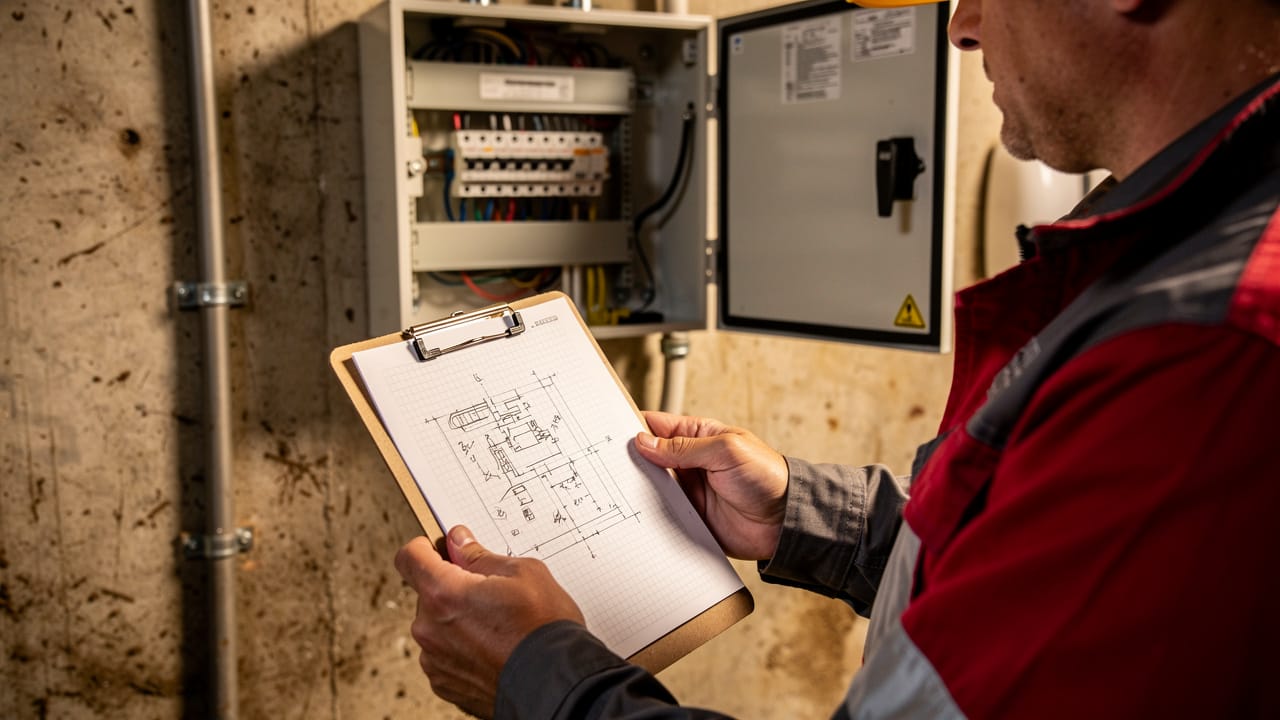
An accurate electrical load calculation for dairy farms starts with a full list of every device that draws power. This sounds simple, but many farms miss items during a quick walk‑through. Any motor, heater, light, outlet, or control panel that can run during milking, feeding, or cleaning needs to be captured.
For each piece of equipment, the nameplate is the source of truth. Do not rely on old invoices or rules of thumb. Record:
-
Voltage and phase
-
Horsepower for motors
-
Amperage or full load amps (FLA)
-
Wattage where listed
-
Whether the load is single‑phase or three‑phase
-
Where it is physically located on the farm
A simple spreadsheet or farm map works well here. Many producers walk the site with a clipboard or tablet and tag each load as they go.
Milking and cooling come first because they are core to the business. This includes:
-
Vacuum pumps and milk pumps
-
Plate coolers and glycol chillers
-
Bulk tank compressors
-
Robotic milking systems and their associated motors, heaters, controls, and pumps
Robotic systems often run around the clock. Bulk tank compressors, in particular, can draw very high current when they start, and that must be reflected in the calculation.
The barn environment is the next major category. Ventilation fans often operate for many hours, so they count as continuous loads. High‑bay LED lighting across a large barn adds up quickly, even though each fixture is efficient. Do not forget stock water heaters, heat tape, and calf barn heaters that protect animals and plumbing during long Alberta winters. Seasonal items, such as extra heating in cold spells, should still be on the list because they drive peak demand.
Feeding and manure systems bring several more large motors into the picture. Stationary TMR mixers, silo unloaders, conveyor lines, gutter cleaners, and manure pumps all come with high starting currents. Add to that:
-
Well pumps and pressure systems
-
Large electric water heaters for wash‑down
-
Pressure washers and cleaning equipment
-
Office equipment and computer systems
-
Workshop tools and welders
-
Any farmhouse loads that share the same service
When Cove Electrical completes an electrical load calculation for dairy farms, this inventory stage is handled carefully, because everything after it depends on getting this list right.
“If it has a motor, a heating element, or a plug, it goes on the list. Guessing here is where most farm power problems begin.”
— Cove Electrical project lead
Applying CEC Demand Factors And Calculating Your Service Size
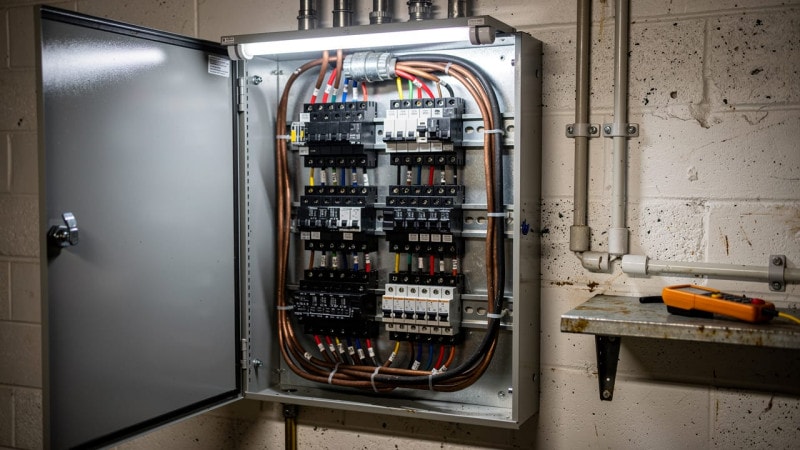
Once all the loads are listed, the next step is to figure out how much power the farm can draw at one time. The goal of an electrical load calculation for dairy farms is to find the demand load, not just the sum of all nameplate ratings. The CEC recognises that not everything runs at full power together, so it provides rules to adjust the raw totals.
A key idea is the difference between continuous and non‑continuous loads:
-
A continuous load is something that runs for three hours or more, such as barn ventilation or general lighting. The CEC requires those circuits to be sized at 125 percent of their actual running amps.
-
Non‑continuous loads, like a manure pump or workshop welder, do not get that 125 percent bump because they run only in short bursts.
With those types in mind, the steps look like this:
-
Group the loads.
Group all loads into logical categories: motors, heating, lighting, and receptacles. Some electricians also group by area (parlour, barn, milk house, workshop) to make later troubleshooting easier. -
Convert everything to amps.
Convert each load into amps at its operating voltage. For resistive loads like heaters or lights, divide watts by volts. For motors, use manufacturer FLA data or the CEC tables rather than a simple formula, because motor efficiency and power factor affect the true draw. -
Apply CEC demand factors.
Apply the CEC demand factors, including the special rules in Section 22 for agricultural buildings. Motor loads are often handled with a tiered approach. For example, the largest motor may be counted at 100 percent, the next largest at 75 percent, the third at 65 percent, and the rest at 50 percent. Heating and lighting have their own rules, which a licensed electrician reads directly from the Code. This method reflects how a dairy farm actually runs during a busy period. -
Add the adjusted loads and compare to standard services.
Add all the adjusted loads together to find the total demand in amps. That number is then compared to standard service sizes, such as 200A, 400A, 600A, or higher. At this stage, another key decision is whether the farm will use single‑phase or three‑phase power.
Single‑phase 120/240V can be enough for smaller sites with motors under roughly 7.5 HP. For larger, modern Alberta dairies with big motors and Variable Frequency Drives (VFDs), three‑phase service gives smoother motor starts, better efficiency, and easier load balancing across phases.
Many farms find it helpful to see a simplified example. Suppose a site has:
-
40A of continuous fan load
-
30A of lighting
-
A 30A vacuum pump motor
-
Several smaller motors adding up to 50A
After applying demand factors and the 125 percent sizing for continuous loads, the total demand used for service sizing may be well below the raw sum of these numbers. This is exactly what the CEC intends: a realistic design that reflects actual usage instead of a worst‑case that never happens.
Applying these demand factors correctly is one of the biggest failure points when an electrical load calculation for dairy farms is done by someone without agricultural experience. Cove Electrical follows CEC Section 22 line by line, designs around real operating patterns, and then selects a service size and distribution that support safe, long‑term operation.
Future-Proofing And Backup Power Planning
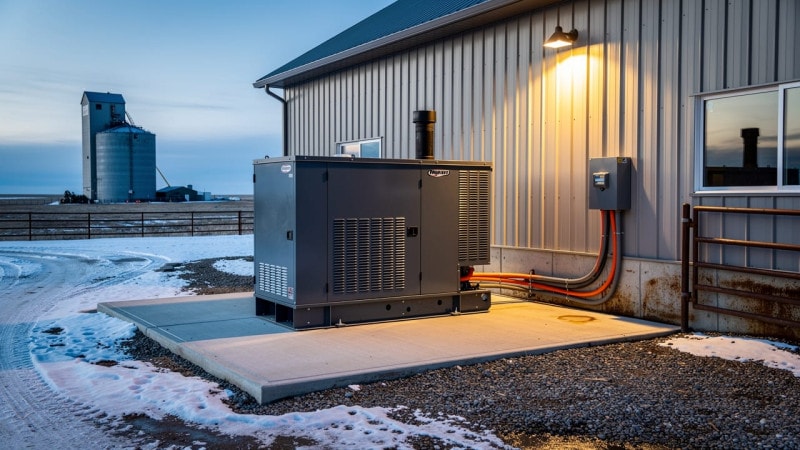
For most Alberta dairies, the operation five or ten years from now will use more power than it does today. Robotic milkers, extra ventilation, new barns, or grain handling can all push a system past its limits. That is why a good electrical load calculation for dairy farms looks ahead, not just at current loads.
From day one, the main panel should have room to grow. A sensible target is at least 25 to 30 percent spare breaker spaces above what is used on opening day. Underground and overhead conduits can be sized with some extra capacity so future feeders or control cables can be added without digging again. Sub‑panels in key locations, such as the barn, milk house, and workshop, help keep feeder lengths shorter and reduce voltage drop to big loads like pumps and mixers.
Modern dairies also rely heavily on Variable Frequency Drives (VFDs) for vacuum pumps, milk pumps, and some fan systems. VFDs give soft starts and energy savings, but they can introduce electrical noise into the system. That means the grounding, bonding, and layout of the system need to be planned with VFDs in mind. When Cove Electrical designs farm systems, VFD compatibility is treated as part of the original layout, not something added later.
Backup power is the other major part of future planning. For a dairy, a generator is not a nice‑to‑have accessory; it is how the farm keeps milking, cooling, and ventilating during storms or grid problems. Generator sizing starts with a separate load calculation for critical circuits only, such as:
-
The milking system
-
Bulk tank compressors
-
Well pump and pressure system
-
Key ventilation fans
-
Limited lighting in work areas
Motors can draw three to six times their running current on startup, so the generator must handle that inrush without stalling or dragging the voltage down.
An Automatic Transfer Switch (ATS) is installed between the utility supply, the generator, and the critical load panel. The ATS watches the incoming grid, disconnects the farm from the line when power fails, starts the generator, and then connects only the circuits chosen in the critical load plan. Cove Electrical designs and installs generator and ATS setups that match the farm’s actual needs, so the backup system supports the same reliability focus as the main service.
“Power outages do not care if cows are ready to be milked. If the generator and transfer switch are sized right, the herd never notices the lights blink.”
— Alberta dairy producer working with Cove Electrical
Regular testing and maintenance of generators and ATS equipment are just as important as sizing. Many farms schedule monthly test runs so that when the grid fails, the backup system performs the way it was designed.
Why Professional Load Calculation Is Non-Negotiable In Alberta
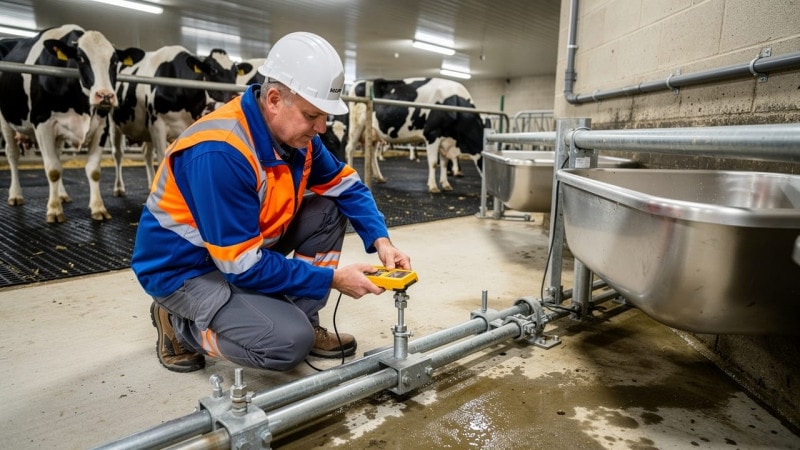
Trying to handle an electrical load calculation for dairy farms without the right background can create expensive and dangerous problems down the road. Common mistakes include:
-
Leaving out future loads and expansion plans
-
Using residential‑grade fixtures and cable in corrosive barns
-
Guessing on motor currents instead of using CEC tables and nameplate data
-
Ignoring voltage drop on long feeder runs to remote barns or pumps
Any of these errors can leave a system overloaded, under‑protected, or short on capacity within a few years.
Grounding and bonding are another area where shortcuts are risky. Incomplete bonding grids or weak connections can create stray voltage that stresses cattle, lowers milk production, and in extreme cases can injure people or animals. Alberta inspectors look closely at these details, and insurance companies expect full CEC compliance. A non‑compliant installation can lead to failed inspections, denied claims, and legal exposure if something goes wrong.
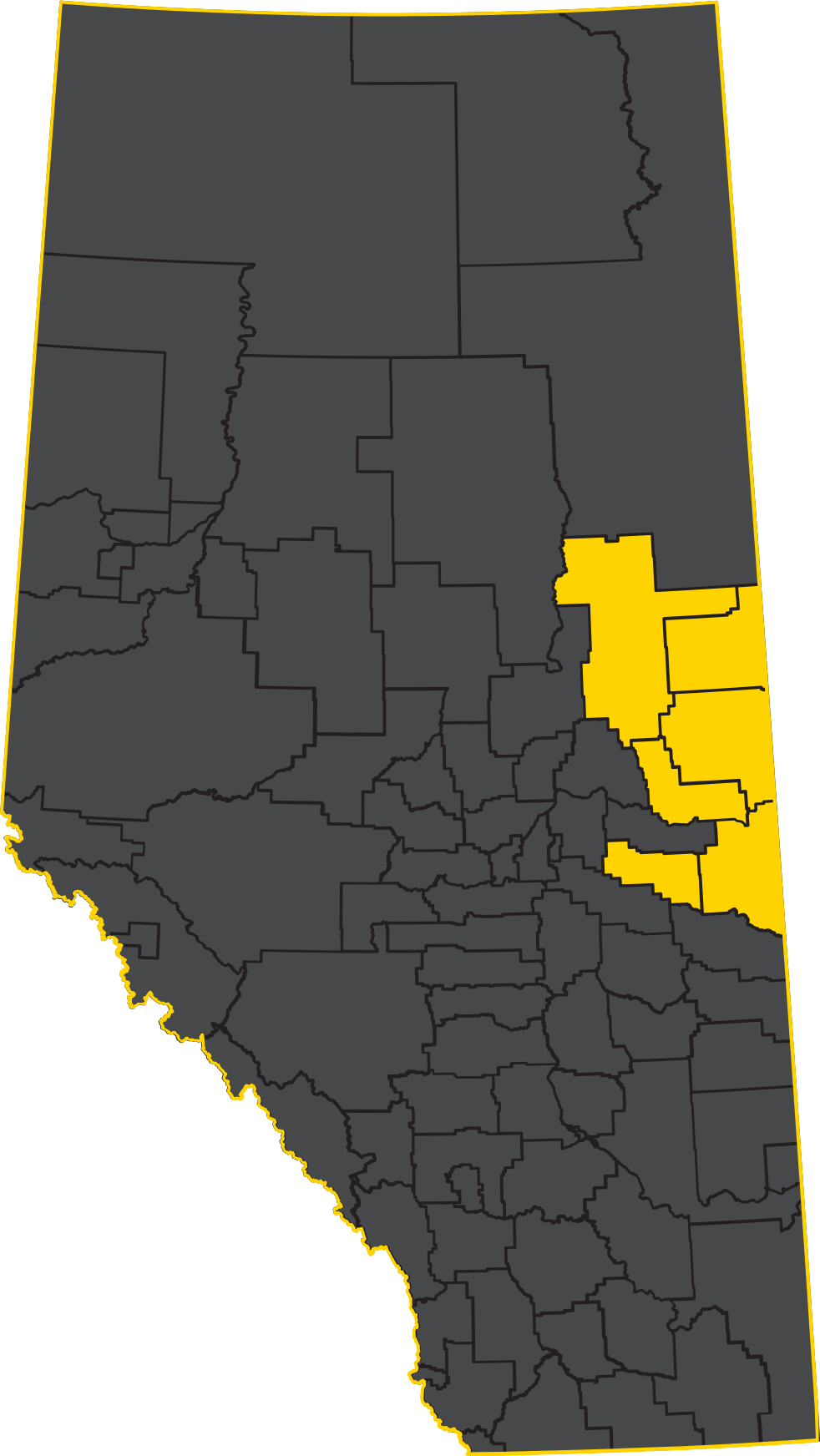
Cove Electrical focuses on operations that cannot afford downtime, including dairy farms across Northeast Alberta. As experienced electrical contractor based near Bonnyville, we:
-
Design farm power systems from the ground up
-
Perform system assessments and capacity checks
-
Upgrade ageing infrastructure and panels
-
Install backup generators and ATS equipment
Our electrical load calculations for dairy farms account for current needs, planned growth, and the harsh conditions found in real barns, not just what looks good on paper.
Conclusion
A safe, reliable Alberta dairy operation starts with the right electrical backbone. That backbone is built on a careful electrical load calculation for dairy farms, followed by proper use of CEC demand factors, sensible service sizing, and detailed planning for how the farm actually runs during milking, cooling, and cleaning.
An undersized or poorly planned system puts animals, staff, equipment, and milk inventory at risk every time the weather turns or production ramps up. Building in space for automation, expansion, and backup power from the start avoids expensive retrofits and unplanned downtime later on. Cove Electrical partners with dairy producers to design and maintain electrical systems that support steady production and animal welfare day after day.
For farm owners and operations managers who want that level of reliability, the next step is simple. Reach out to Cove Electrical for a professional assessment of your current farm power and a load calculation built for Alberta conditions, CEC compliance, and long‑term performance.
FAQs
What Size Electrical Service Does A Dairy Farm In Alberta Typically Need?
There is no single standard service size that works for every Alberta dairy. The required size depends on the total demand load after a proper electrical load calculation for dairy farms, including CEC demand factors. Smaller sites may work with 200A service, mid‑sized farms often need 400A, and larger automated facilities can require 600A or more. A licensed agricultural electrician should size the service with extra capacity for planned growth and any known future projects, such as robotic milking or an additional barn.
Do Dairy Farms In Alberta Need Three-Phase Power?
Three‑phase power is strongly recommended for most modern dairy operations in Alberta. It allows larger motors, such as vacuum pumps and compressors, to run more smoothly and efficiently, and it supports VFDs and better load balancing. A small farm with only a few modest motors may operate on single‑phase service. The best answer comes from a farm‑specific electrical load calculation and a review of future plans with a licensed agricultural electrician like Cove Electrical.
What Does The Canadian Electrical Code Say About Wiring In Dairy Barns?
The Canadian Electrical Code, particularly Section 22, treats dairy barns as locations with moisture, corrosive gases, and frequent wash‑down. It calls for corrosion‑resistant wiring methods and conduit, sealed wet‑location fixtures, and enclosures with ratings such as NEMA 4X. The Code also requires an equipotential bonding grid where livestock stand, to reduce stray voltage and protect animals. Non‑compliant wiring can lead to failed inspections, serious safety risks, and insurance problems, so it is vital to have barn work designed and installed by a licensed electrician who knows agricultural rules and local inspection practices.